
Matching Custom Wet Wipes to Industry and Project Scenarios
A custom wet wipes specification is not chosen in the abstract. It is chosen by the industry the wipe ships into, the project type behind the order, and the market where the claim will be read. Buyers who start with a product name and work backwards usually end up re-specifying after the artwork is approved.
This guide works the other way round. It begins with the scenario — infant care, pet grooming, home cleaning, general merchandise, contract manufacturing — and then shows which part of the specification that scenario actually locks. It covers the Sunfans lines supplied for these programs: baby wipes Y02, pet wipes C02 to C05, wet toilet paper S01 and S02, kitchen wipes CF001, clothing wipes YW01 and eye care wipes YJ01.
Everything below is drawn from the supplier's product specification, scenario, capability and certification records. Where those records are silent — unit prices, product-specific flushability testing, regulatory classification outside the United States and Japan — the guide says so instead of filling the gap.
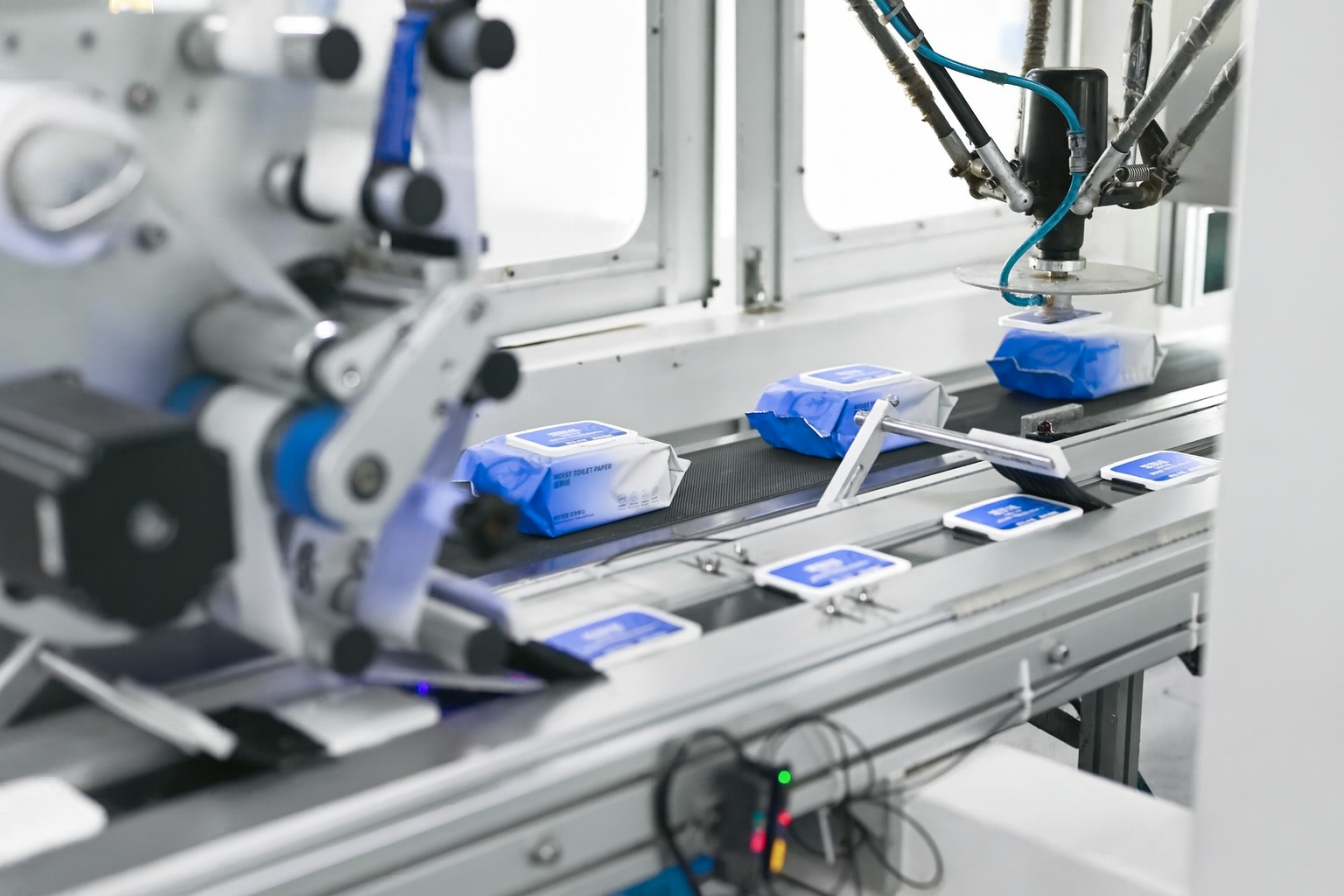
Production line for OEM and contract-manufacturing wet wipes programs.
Why the scenario decides the specification
The scenario decides which constraints are fixed and which are negotiable. Sheet size, pack count and even substrate can move within a range. Intended use, claim wording and the documents that support them cannot move after packaging copy is signed off.
Five layers bind a custom wet wipes order, and they bind in this order:
- Intended use and claim language — what the wipe says it does, and to whom.
- Format and ordering unit — wipes counted in pieces, sheets, or glove pairs.
- Substrate and sheet area — the material named in the specification and the rectangle it is cut to.
- Hygiene and process equipment — the cleanroom class, water treatment and sterilization behind the line.
- Documentation scope — certificate, safety data sheet and tariff code, each attached to a specific product rather than to the factory in general.
Layer one outranks the rest because it changes the product's legal category, not its quality grade. Under U.S. Food and Drug Administration guidance, wipes intended for cleansing or moisturizing skin — baby care, hand washing, personal cleansing — are regulated as cosmetics. Wipes making therapeutic claims, such as killing germs on skin or treating acne or diaper rash, are regulated as drugs. Wipes intended to disinfect or sanitize inanimate surfaces, or containing insect repellents, may fall under Environmental Protection Agency regulation, while wipes for cleaning objects are associated with Consumer Product Safety Commission oversight (U.S. FDA guidance, 2024).
What changes between scenarios — and what does not
Six scenario records cover large shopping malls, general merchandise, home cleaning, pet supplies, baby and maternity products, and the manufacture of disposable sanitary products. All six share the same project type (OEM branding and contract manufacturing), the same function description, the same operation mode (continuous surface wiping, single-sheet one-time consumption), the same storage condition (cool, dry, shaded area at room temperature, away from heat sources and moisture), and the same special requirement: a gentle, plant-based formula free of alcohol, with fabrics that are gentle on the skin and free of irritating additives.
All six also list the full ten-product range as related products. That is the detail buyers most often misread. The scenario record does not say 'this industry needs this wipe'. It says the factory can serve that industry with any of these formats. The matching work therefore sits with the buyer, and two buyers ordering the same C03 for the same industry can still need different pack counts, different claim wording and a different document set.
What genuinely changes from scenario to scenario is narrower but more consequential: the ordering unit, the sheet area, the pack count, and the documents that have to line up with the exact SKU.
The process baseline behind all six records is identical and specific: automatic filling machines, automatic packaging machines, EDI ultra-pure water equipment, a UV sterilization system, an in-house laboratory, a Class 100,000 cleanroom and a pH meter. These are the items an audit should confirm on site, because they are process conditions rather than marketing statements.
Infant care: claim language outranks capacity
Baby wipes Y02 are specified at 150 × 200 mm in an entirely adhesive material, English-version pack, 01–100 pieces, for the infant care products industry, the baby hygiene products industry, and large department stores and supermarkets. The certification records map the ISO 9001:2015 certificate to Y02 specifically.
The wide piece range is the most under-used part of that specification. One model family can serve a travel pack and a bulk household pack without changing the sheet. The pack-count decision is therefore a channel and shelf decision, not a production limit — which means it should be made from retail data, not from the factory's convenience.
The binding constraint for infant care is documentation, not tonnage. A baby wipe sold into the United States sits in the cosmetic category described above: no pre-market approval, but mandatory safety compliance. The supplied records do not include a lotion formulation, preservative system, pH target or microbiological limit for Y02, so those items have to be requested as a technical data sheet plus a certificate of analysis per shipment.
The material wording deserves the same care. 'Entirely adhesive' is the record's description of the substrate; it is not a fibre claim that can be printed on pack. Confirm the composition on the technical data sheet before any material wording goes to the designer.
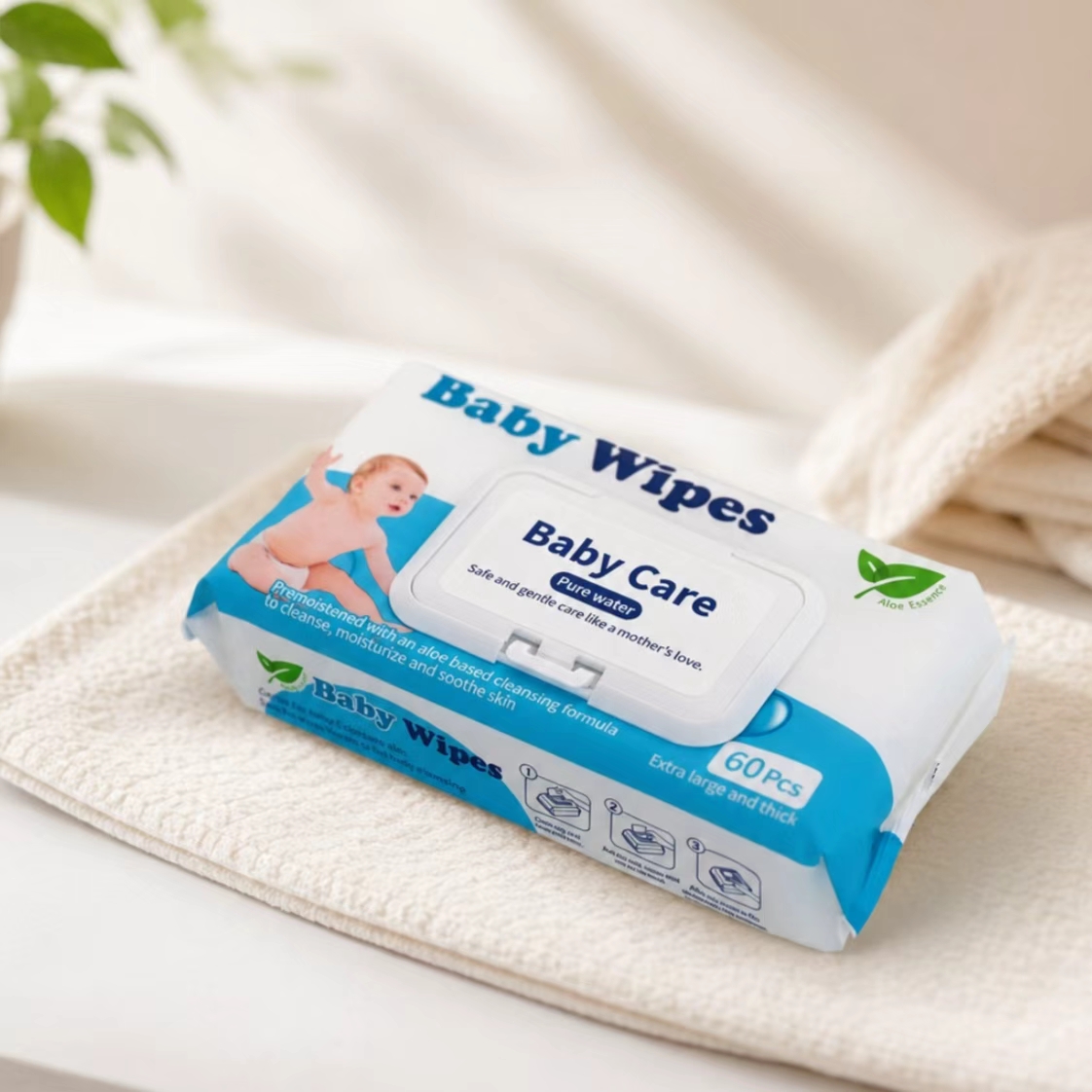
Baby wipes Y02, specified at 150 × 200 mm with a 01–100 piece pack range.
The supplier's program records include a baby and maternity brand owner running 20 forty-foot containers per month across five years, and a baby products seller on Amazon.com at 8 containers per month across four years. Both are supplier-reported records rather than independently audited results, but they describe the order shape a baby-wipe program typically settles into: one model, one substrate, many pack counts.
Pet grooming: three formats, three ordering units
The pet range is where scenario matching gets concrete, because the four models are not variations of one product:
- C02 — pet wet wipes, 200 × 200 mm, entirely adhesive, 01–100 pieces.
- C03 — pet wet wipes, 150 × 200 mm, bamboo fiber, 02–100 pieces.
- C04 — pet wet toilet paper, 140 × 180 mm, bamboo fiber, 03–100 sheets.
- C05 — pet gloves, 180 × 200 mm, biodegradable wood pulp non-woven fabric, 04–10 pieces.
All four are listed for the pet products industry, the pet grooming and personal care segment, and large department stores and supermarkets. The ordering unit is the first thing that changes: C02, C03 and C05 are counted in pieces, C04 in sheets. A purchase order that quotes 'packs' without stating the unit is not a comparable order, and the acceptance count on the dock will differ by format.
Substrate is the second decision, and it carries documentation weight rather than only positioning. C03 and C04 use bamboo fiber; C05 uses biodegradable wood pulp non-woven fabric; C02 uses an entirely adhesive material. A 'biodegradable' claim on pack needs product-specific test evidence, and the supplied records do not contain biodegradability test reports for any pet model. Treat the material name as the starting point of the claim and ask for test reports before printing it.
The MSDS on file is scoped to the glove format — 'Pet Grooming Glove Wet Wipes for Dogs & Cats (Extra Thick Rinse-Free Cleaning Gloves)' — issued under OSHA 29 CFR 1910.1200 HCS. It does not automatically cover C02, C03 or C04. Buyers who assume one safety data sheet covers a four-model pet range will find the gap at customs or at retail onboarding.
For the pet-supplies scenario record, which lists C05 among its matched products, the matched equipment includes the Class 100,000 cleanroom alongside EDI ultra-pure water, UV sterilization, automatic filling and packaging, an in-house laboratory and a pH meter. Those are the conditions to verify during a factory audit, and they are the reason a pet glove program is a different supplier conversation from a kitchen wipe program.
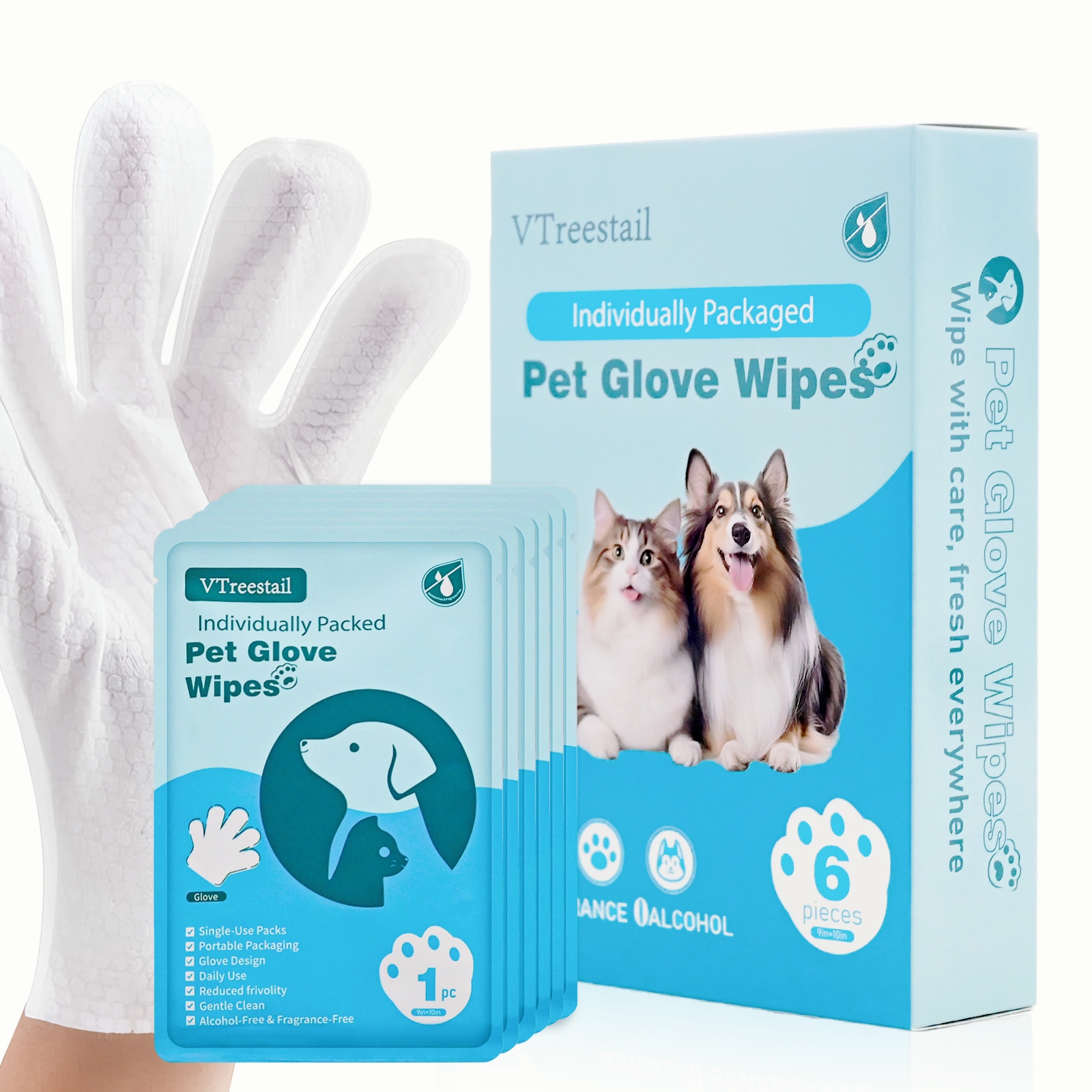
Pet gloves and pet wipes from the C-series grooming range.
A pet supplies seller on Amazon.com has run 8 forty-foot containers per month for six years in the supplier's program records — the longest-running pet account in that record set. The evaluation order that record implies is format first (wipe, toilet paper or glove), substrate second, pack count third.
Home cleaning and toilet paper: disintegration is not flushability proof
Wet toilet paper S01 is specified at 130 × 200 mm, 100 sheets, in biodegradable wood pulp non-woven fabric. Its specification record lists the pet products industry, large department stores and the personal care products industry; the home cleaning scenario record also covers it. S02 is specified at 150 × 200 mm, 10 sheets, in a material that can be disintegrated into wood pulp cloth.
That disintegration statement is a material property. It is not a flushability certification, and the difference matters commercially. FDA guidance notes that some wipes are labeled flushable, but the available evidence does not validate a specific flushability standard or a product-specific test result for any supplier. Before 'flushable' goes on a pack, fix four things: the named test method, the complete test report, the product identifier the report refers to, and the claims position for each destination market.
Pack count splits the two models into different channels. A 10-sheet pack suits companion, travel or washroom-adjacent positioning; a 100-sheet pack suits household replenishment. Both carry the same storage condition, so warehousing is not the differentiator — velocity per pack is.
For Japan-bound orders, Japan Customs tariff documentation uses HS Code 3401.19.000 for wet tissues. That is a documentation item to confirm with the customs broker at order stage, not a substitute for a product classification review.
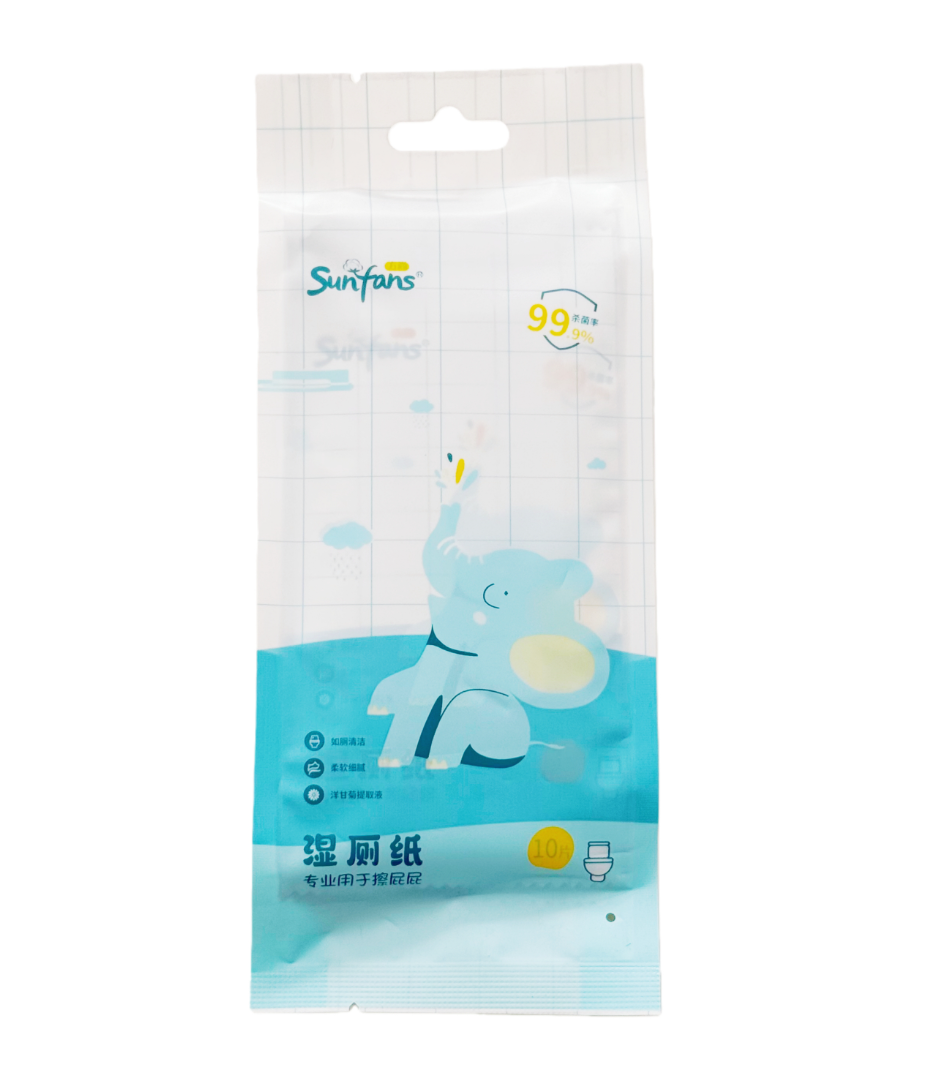
Wet toilet paper from the S-series range.
Kitchen, clothing and eye care: three jobs under one industry label
All three models are listed for the home cleaning industry, large retail chains and the general merchandise industry, and all three fall under OEM branding and contract manufacturing. Their specifications, however, describe three different jobs:
- CF001 — kitchen wet wipes, 200 × 200 mm, water-jet non-woven fabric, 80 pieces.
- YW01 — clothing wipes, 150 × 180 mm, water-jet non-woven fabric, 10 cloths for drying clothes.
- YJ01 — eye care wipes, 100 × 150 mm, water-resistant paper, 20 pieces, described as eye glass cleaning cloths.
The material choice sets what each product can credibly be asked to do. Water-resistant paper on an optical surface is a different engineering decision from water-jet non-woven fabric on a kitchen counter or a garment. Consolidating all three onto one purchase order is practical — the same supplier covers all three — but the acceptance criteria are not interchangeable. An optical cloth is judged on dimension accuracy and residue; a kitchen wipe is judged on wet strength and pack seal; a clothing wipe is judged on how it handles a drying task without leaving fibre.
Sheet area, calculated from the supplied dimensions as rectangles, ranges from 15,000 mm² for YJ01 to 40,000 mm² for CF001 and C02 — a 2.7× spread across the range. Since substrate volume scales with area, two products quoted at the same pack price are rarely at the same material cost.
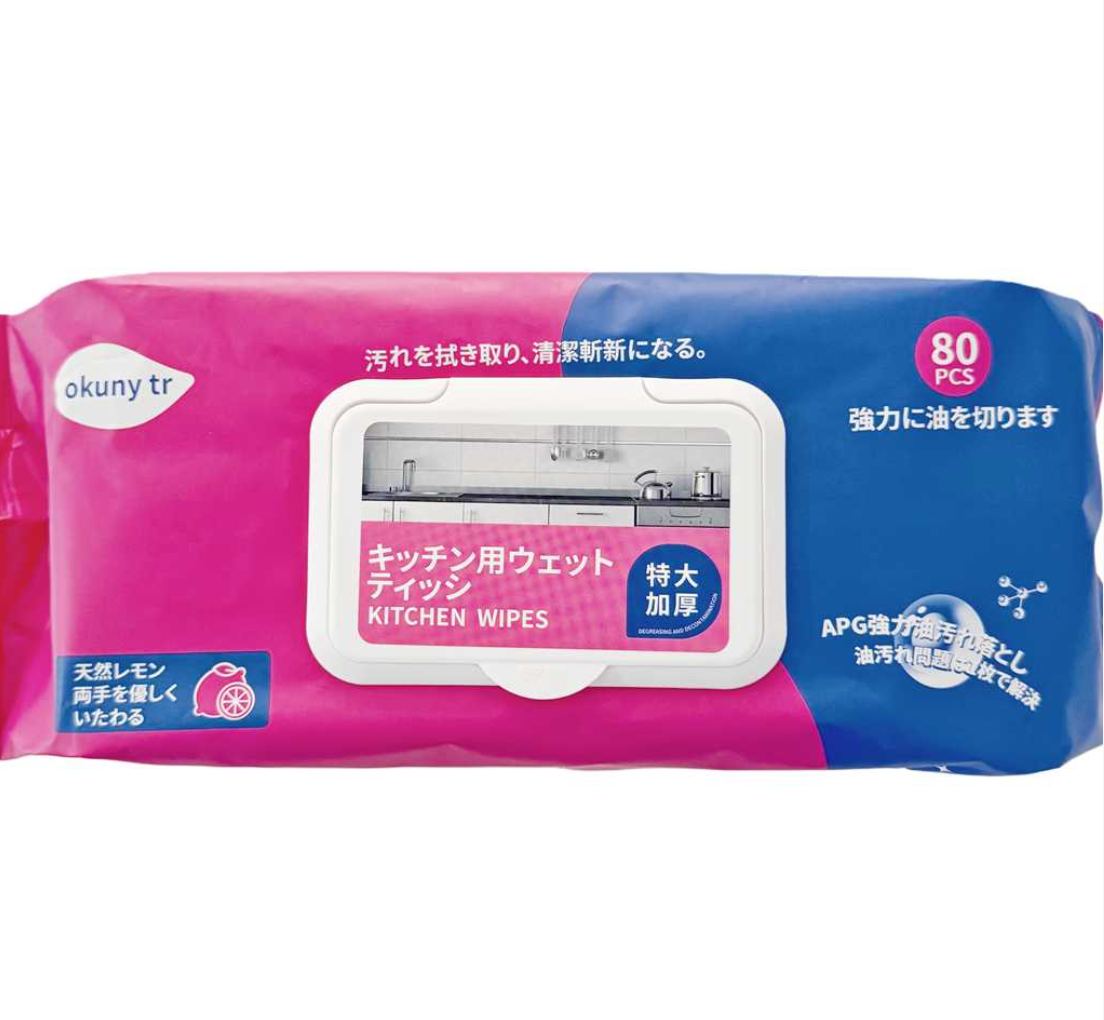
Kitchen wet wipes CF001, 200 × 200 mm, 80 pieces.
Because these three models sit inside contract-manufacturing projects, the customisable fields matter as much as the base specification: packaging, logo, material, size, aroma and number of pieces are all recorded as open to customisation. Each field a buyer changes is a field that must be re-approved on the sample before bulk production.
Scenario-to-spec comparison table
| Model | Product | Sheet size | Material (as specified) | Format & pack | Intended industry (specification record) |
|---|---|---|---|---|---|
| Y02 | Baby wipes | 150 × 200 mm | Entirely adhesive | English version, 01–100 pieces | Infant care products; baby hygiene products; large department stores and supermarkets |
| C02 | Pet wipes | 200 × 200 mm | Entirely adhesive | 01–100 pieces | Pet products; pet grooming and personal care; large department stores and supermarkets |
| C03 | Pet wipes | 150 × 200 mm | Bamboo fiber | 02–100 pieces | Pet products; pet grooming and personal care; large department stores and supermarkets |
| C04 | Pet wet toilet paper | 140 × 180 mm | Bamboo fiber | 03–100 sheets | Pet products; pet grooming and personal care; large department stores and supermarkets |
| C05 | Pet gloves | 180 × 200 mm | Biodegradable wood pulp non-woven fabric | 04–10 pieces | Pet products; pet grooming and personal care; large department stores and supermarkets |
| S01 | Wet toilet paper | 130 × 200 mm | Biodegradable wood pulp non-woven fabric | 100 sheets | Pet products; large department stores; personal care products (home cleaning scenario also covers it) |
| S02 | Wet toilet paper | 150 × 200 mm | Can be disintegrated into wood pulp cloth | 10 sheets | Home cleaning; general merchandise |
| CF001 | Kitchen wipes | 200 × 200 mm | Water-jet non-woven fabric | 80 pieces | Home cleaning; large retail chains; general merchandise |
| YW01 | Clothing wipes | 150 × 180 mm | Water-jet non-woven fabric | 10 cloths for drying clothes | Home cleaning; large retail chains; general merchandise |
| YJ01 | Eye care wipes | 100 × 150 mm | Water-resistant paper | 20 pieces (eye glass cleaning cloths) | Home cleaning; large retail chains; general merchandise |
Specifications and industry listings as recorded in the supplier product data; sheet-area figures elsewhere are calculated from these dimensions.
Six steps from scenario brief to locked specification
The sequence below is the shortest route from an industry brief to a purchase order that will not be renegotiated at sample stage.
- 1. Freeze intended use, market and claim wording. Decide whether the wipe is positioned as skin-cleansing, therapeutic or surface-cleaning, and for which country. This step sets the regulatory pathway before any model is discussed.
- 2. Choose the format and record the ordering unit. Wipes in pieces, toilet paper in sheets, gloves in pieces. The unit goes into the quotation request verbatim.
- 3. Fix sheet size and pack count inside the model's stated range. Y02 and C02 allow 01–100 pieces; C05 is a 04–10 piece glove format; S02 is a 10-sheet pack. Choosing outside a stated range is a new specification, not a pack variant.
- 4. Confirm the substrate and any material claim. Request the technical data sheet for the named material, and for biodegradable or flushable wording, request the product-specific test report behind the claim.
- 5. Map documents to the SKU. Check that the certificate or safety data sheet names the product it is supposed to cover, not just the factory.
- 6. Write acceptance criteria and terms into the PO. Dimension tolerance, pack count, seal integrity, document set, MOQ, lead time and nonconformance handling.
Where these programs run: documented project profiles
The supplier's program records describe long-running order shapes rather than one-off shipments. A retail-store program in Japan ran 15 forty-foot containers per month across three years; an e-commerce retail account ran 15 containers per month across three years; a household and personal care conglomerate ran 10 containers per month across eight years; a 150-year-old conglomerate ran 10 containers per month across ten years. Each is recorded with the same reported result — stable everyday cleaning with reduced environmental impact — and the same reported highlight: quality remains stable over the long term, with new products proposed continuously.
Read as order shapes, these profiles are useful for one decision in particular: how much of the specification can be allowed to change after year one. A program running at double-digit container volumes does not survive repeated substrate or pack-count changes, which is why the specification should be locked at step six rather than revisited each season.
Certification scope: matching the document to the SKU
The supplier holds ISO 9001:2015 certification, certificate number 0350125030471R1S, issued by Xingyuan Certification Centre Co., Ltd. on 12 June 2025 and valid to 6 June 2028. The applicable standard is GB/T 19001-2016 / ISO 9001:2015, and the scope covers the production and service of wet wipes within the licensed scope, for the global market. The certification records map this certificate to baby wipes Y02, kitchen wipes CF001 and pet wipes C02.
A separate MSDS is on file for the pet grooming glove wipes: number BMi202605192227DG, issued by Zhuhai BMi Certification & Testing Co., Ltd. on 19 May 2026 and valid to 20 May 2027, prepared in accordance with OSHA 29 CFR 1910.1200 HCS and applicable to the global market.
Two boundaries are worth stating plainly. A management-system certificate covering production and service of wet wipes within the licensed scope does not certify the performance of every SKU that leaves the plant. An MSDS is a hazard-communication document, not a market authorisation, and this one is scoped to the glove format. Both are necessary; neither replaces a product-specific test report or a market-entry classification review for the destination country.
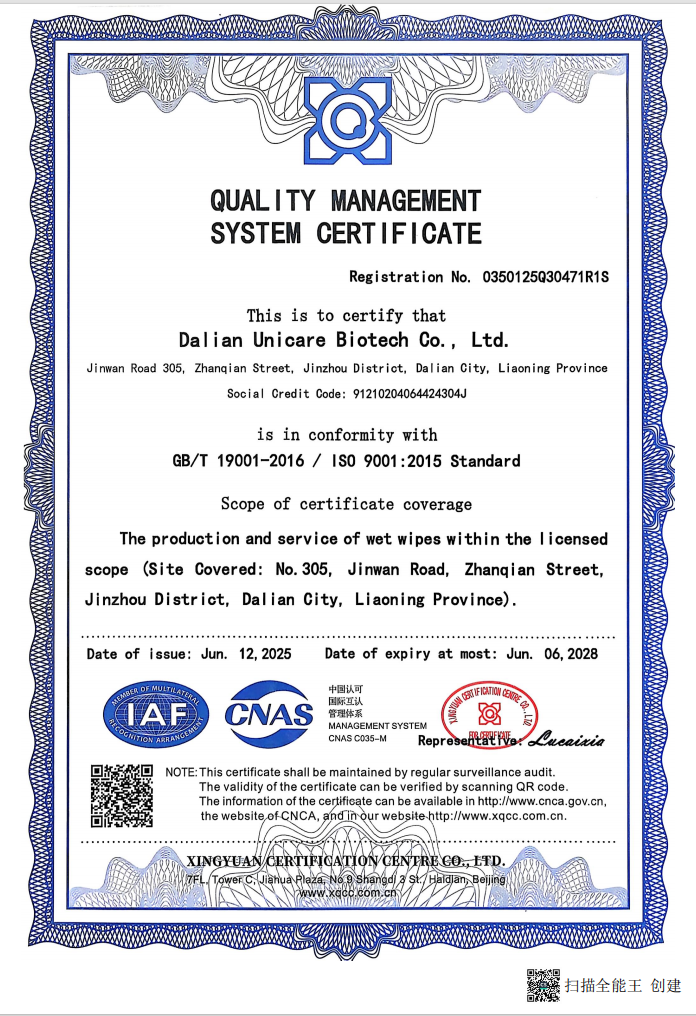
ISO 9001:2015 certificate covering production and service of wet wipes within the licensed scope.
Purchase terms and acceptance criteria to raise per scenario
The commercial baseline in the capability record is a stated minimum order of 20,000 yuan (package), a 30-day lead time, a monthly capacity of 3 million packages, and assistance with verifying packing lists and customs declaration documents for export orders. Export markets listed are Japan, Singapore, New Zealand, Australia, the United States, Southeast Asia and Canada. No verified unit prices are included in the supplied data, so the price band has to be built from cost drivers rather than quoted from this page.
Those drivers are visible in the specification: sheet area (calculated at 15,000 to 40,000 mm² per sheet across this range), substrate type, pack count, how many customisation fields change — packaging, logo, material, size, aroma, number of pieces — and the processing behind the line, including the Class 100,000 cleanroom, EDI ultra-pure water and UV sterilization. A per-pack price quoted without sheet size and pack count is not a comparable price.
Scenario-specific questions to put into the quotation request:
- Infant care (Y02): technical data sheet for substrate and lotion, certificate of analysis per batch, pack-count tolerance, seal integrity test, and confirmation that Y02 is inside the ISO 9001 certificate scope.
- Pet grooming (C02–C05): which exact model the MSDS covers, the ordering unit in pieces or sheets, glove dimensions and thickness for C05, and the test reports behind any biodegradable wording on C03, C04 or C05.
- Wet toilet paper (S01, S02): the named disintegration or flushability test method, the full report with product identifier, sheet count verification, and the claims position for each destination market.
- Kitchen, clothing, eye care (CF001, YW01, YJ01): substrate grade confirmation, dimension tolerance against 200 × 200 mm, 150 × 180 mm and 100 × 150 mm, artwork and aroma approval on the sample, and separate acceptance criteria per product rather than one shared line.
- All scenarios: storage condition confirmation, MOQ per SKU, lead time per SKU, packing list and customs documentation support, and the process for nonconforming batches.
FAQ
Which certificates actually apply to a baby or pet wipe program?
Two documents are on file. The ISO 9001:2015 certificate, number 0350125030471R1S from Xingyuan Certification Centre Co., Ltd., was issued on 12 June 2025, is valid to 6 June 2028, follows GB/T 19001-2016 / ISO 9001:2015, and covers production and service of wet wipes within the licensed scope; the certification records map it to Y02, CF001 and C02. The MSDS, number BMi202605192227DG from Zhuhai BMi Certification & Testing Co., Ltd., was issued on 19 May 2026, is valid to 20 May 2027, follows OSHA 29 CFR 1910.1200 HCS, and covers the pet grooming glove wipes for the global market. Neither document certifies the performance of every SKU, so ask the supplier to confirm in writing which product each document covers.
Can one supplier program cover baby, pet, toilet paper, kitchen, clothing and eye care lines?
The supplied range includes all six areas: Y02 baby wipes, C02 to C05 pet wipes, S01 and S02 wet toilet paper, CF001 kitchen wipes, YW01 clothing wipes and YJ01 eye care wipes. Customisation covers packaging, logo, material, size, aroma and number of pieces, with a monthly capacity of 3 million packages and a 30-day lead time. One supplier, however, does not mean one specification: each SKU keeps its own sheet size, material, pack count and document set, and those items have to be confirmed line by line.
What drives the price band when no unit price is published?
The supplied data contains no verified unit prices, so the band is built from cost drivers: sheet area, which calculates to between 15,000 and 40,000 mm² per sheet across this range; the substrate named in the specification; the pack count; how many customisation fields change; and the processing behind the line, such as the Class 100,000 cleanroom, EDI ultra-pure water and UV sterilization. The stated minimum order is 20,000 yuan (package). Request a quotation per SKU and per pack count, because a price without sheet size and pack count cannot be compared across suppliers.
How should samples be validated per scenario?
Order the sample against the exact model, sheet size, material and pack count you intend to buy. Request the technical data sheet and a certificate of analysis with the sample. Confirm in writing whether the MSDS on file covers your SKU, since it is scoped to the pet grooming glove format. For S02, ask for the named disintegration or flushability test method and the complete report. Measure the delivered sheet against the recorded dimensions — 150 × 200 mm for Y02, 200 × 200 mm for C02 and CF001, 100 × 150 mm for YJ01 — and check the pack count, closure and seal before approving bulk production.
What purchase terms and lead time should be fixed before ordering?
Fix the following in the purchase order: the SKU and ordering unit, sheet size and pack count, substrate, MOQ of 20,000 yuan (package), the 30-day lead time, the acceptance criteria specific to that scenario, the document set, the storage condition of a cool, dry, shaded area at room temperature away from heat and moisture, and the scope of packing list and customs declaration support. Buyers who want to test one scenario before committing can request samples and a per-SKU quotation to compare pack counts on equal terms; the English company profile linked below summarises the range and documents referenced here.
Conclusion
Scenario matching is a sequence, not a catalogue exercise. The industry and project type fix the claims and the regulatory pathway; the claims fix the documents; the format fixes the ordering unit; the substrate and sheet area fix the material cost; and only then do pack count, artwork and price become meaningful comparisons. Applied to this range, that sequence gives baby wipes Y02 a documentation-first brief, pet wipes C02 to C05 a format-first brief, wet toilet paper S01 and S02 a claims-and-testing brief, and kitchen, clothing and eye care wipes three separate acceptance briefs under one industry label.
Downloads and next steps: the Sunfans company profile (English, PDF) covers the range and facility background. For a sample set or a per-SKU quotation, contact the team at 18525541199@163.com or visit www.unilibio.com.
Have Questions or Need More Details?
Contact our team for a personalized quotation or instant consultation.
Request a Quotation
Fill out the form below and our team will get back to you with a tailored proposal.
WhatsApp Direct Chat
Prefer to chat in real-time? Message us on WhatsApp for instant assistance & quick answers.
- Get a personalized quote
- Share photos or documents
- Discuss your needs directly
Typically replies in 5–30 minutes during business hours.