
Custom Wet Wipes Audit: Cleanroom, Water & Formula Proof
A compliance file for a custom wet wipes order can run to fifty pages and still leave the buyer unable to answer four questions: which product does this document cover, which room was it made in, which formula was assessed, and which batch is inside the container? Those four questions are what an evidence request is for, and the time to ask them is before the purchase order, not after the first delivery.
This guide works through the evidence to request for three production claims that appear in a custom wet wipes program — Class 100,000 cleanroom production for C05 biodegradable pet wipes, EDI ultra-pure water and UV sterilization equipment on the C03 bamboo fiber line, and the plant-based, alcohol-free S02 wet toilet paper formula — then shows how to convert the returned documents into acceptance criteria an order can actually enforce.
Sunfans is the custom wet wipes brand covered here, produced by Dalian Weijie Biotechnology Co., Ltd., established in 2013 in Dalian, Liaoning Province, with a 6,000 m² factory, a 10-person in-house R&D team and an export share of roughly 70% across Japan, Australia, Canada, the United States and Singapore. The company runs OEM, ODM and customized production with a stated monthly capacity of three million packages, a 30-day lead time and a minimum order quantity of 20,000 yuan per package. Those figures are useful context for the checklist below, because they show the scale the evidence file has to cover, but none of them is compliance evidence in itself.
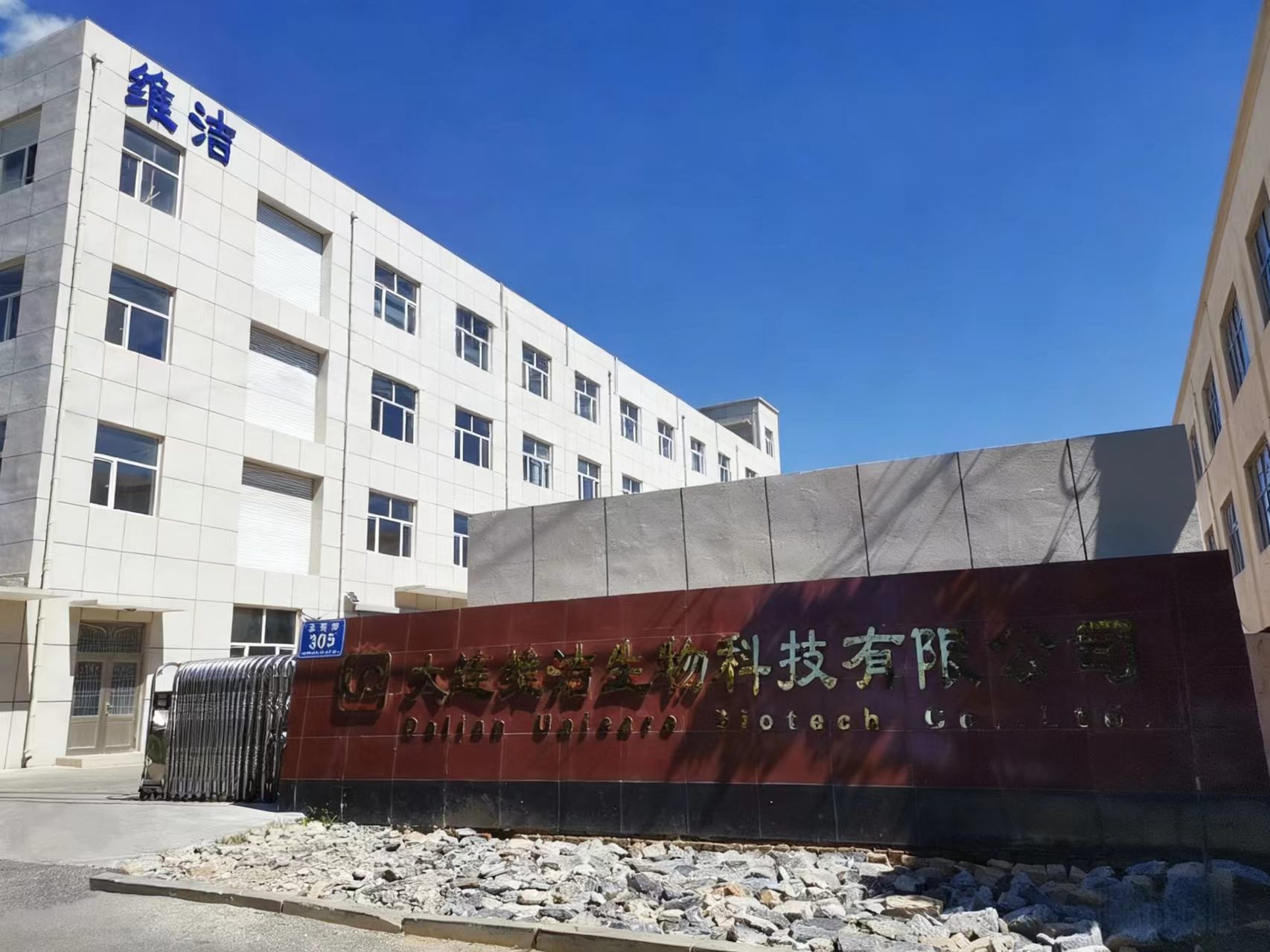
The factory entrance: the site-level documents sit here, the product-level documents do not.
Compliance is decided at three levels, and each produces different documents
The word compliance hides three separate questions. The first is regulatory: how is this product classified in the destination market, and what may its label claim? The second is site-level: what quality system, cleanroom grade, water treatment and sterilization equipment stand behind production? The third is batch-level: what records tie one production run to the specification you approved?
Most supplier folders are strong at level two and thin at levels one and three. Level-two documents — a certificate, a brochure page, a classification statement — are easy to copy and share, while batch records have to be assembled for a specific order. A buyer who receives a folder of certificates has usually verified the site, not the product.
The practical rule is to request all three levels in one package and to score every document on the same three points: does it name my product or model, does its issue date sit inside its validity window, and does it come from an issuer I can check independently?
Why a single certificate claim fails the review
Two documents are offered so often that they deserve individual treatment, because both are genuinely useful and both are routinely over-read.
The first is the ISO 9001 certificate. The one held for wet wipes production is certificate 0350125030471R1S, issued on 12 June 2025 by Xingyuan Certification Centre Co., Ltd. against GB/T 19001-2016 / ISO 9001:2015, valid until 6 June 2028, and scoped to 'production and service of wet wipes within the licensed scope'. A buyer can check the certificate number, the issuer, the standard and the dates, and should. What the certificate establishes is that a quality management system has been certified for a defined scope. What it does not state is the cleanliness class of any room, the quality of the water used in the wetting solution, or which ingredients are excluded from a formula.
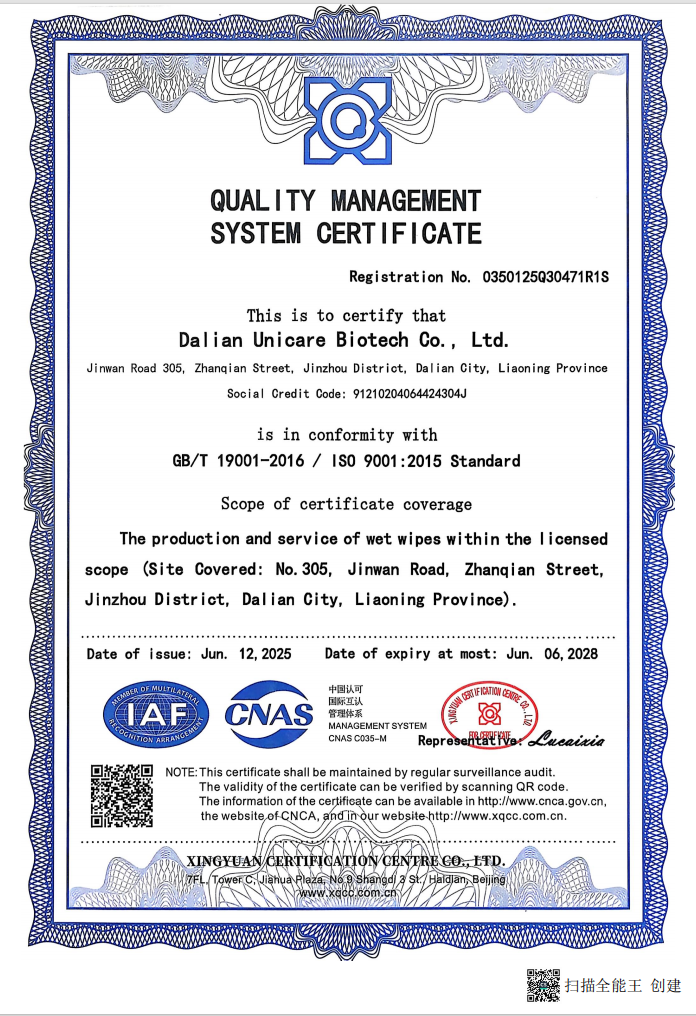
Certificate 0350125030471R1S: check number, scope and validity before the logo.
The second is the material safety data sheet. The MSDS on file, BMi202605192227DG, was issued on 19 May 2026 by Zhuhai BMi Certification & Testing Co., Ltd. under OSHA 29 CFR 1910.1200 HCS, valid to 20 May 2027, and its stated scope is a single item: pet grooming glove wet wipes for dogs and cats, extra-thick rinse-free cleaning gloves. That is solid evidence for that item. It is not evidence for a newborn wipe formula, and a buyer who files it as a general chemical-safety document has verified nothing about the product being ordered.
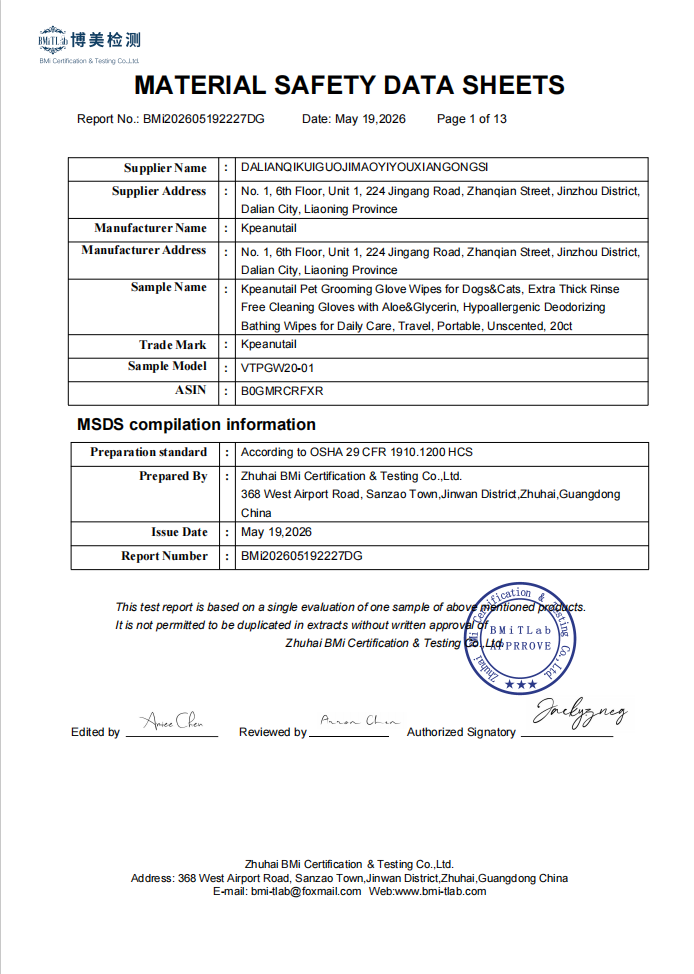
MSDS BMi202605192227DG: product-specific, and dated, which is the point.
Both cases point to the same review habit: read the scope line and the validity dates before the cover page. A document that does not name your product, model or formula has not answered your question, whatever logo sits at the top.
Three production claims, three different record sets
Cleanroom class, water purity and formula restrictions are three different control systems with three different failure modes, so they need three different sets of records. Asking for 'the compliance documents' invites a folder; asking for these specific items invites evidence.
Class 100,000 cleanroom production for C05 biodegradable pet wipes
Class 100,000 is a cleanliness grade from the older US federal standard and corresponds to ISO 8 under ISO 14644-1, the framework most current cleanroom reports use. The claim is checkable, but only against a report rather than a sentence in a brochure. For the C05 biodegradable pet wipes line, request:
- The cleanroom classification report with the room identifier, the sampling points used and the date of the test.
- Particle counts taken both at rest and during operation, because a room that only holds its grade when empty says little about production conditions.
- Microbial monitoring results — settle plates, active air samples and surface swabs — with the applied limits and a trend rather than a single pass.
- Pressure differential and air-change records, together with the HVAC maintenance schedule.
- Gowning procedure and room-entry logs; classification does not control behaviour.
- A change record for any HVAC, layout or workflow modification since the last classification test.
What this set does not establish is that a particular shipment was converted and packed inside that room on a given day. That link is a batch-record question, and it belongs in the same request rather than in a later email.
EDI ultra-pure water and UV sterilization on the C03 bamboo fiber line
Water is the largest single ingredient in a wet wipe, which makes water treatment a formula control as much as an equipment feature. Electrodeionization produces high-purity water continuously by removing dissolved ions, and ultraviolet treatment around 254 nm is used to inactivate microorganisms in the loop. Neither device guarantees an outcome on its own: both need monitoring records to show they were working during the production window. For C03 bamboo fiber pet wipes, request:
- A process diagram of the water system, from incoming supply through EDI and UV to the wetting-solution mixing point.
- Conductivity or resistivity logs, with the alarm limits that trigger rejection of the water.
- Microbiological results at the point of use, not only at the outlet of the treatment skid.
- UV lamp details: model, lamp count, intensity or dose records, running hours and the replacement interval actually followed.
- Sanitization and loop-maintenance records, including the procedure after a shutdown.
This is the difference between 'we have EDI and UV' and 'the water used in this production window met the specification'. The first is a feature statement; the second is evidence.
Formula restrictions on S02 wet toilet paper
The S02 wet toilet paper formula is described as plant-based, alcohol-free and free of irritating additives. Those are three separate claims, and each needs a definition before it can be tested. Request:
- A full ingredient declaration, using INCI names where the destination market expects them, with percentages or concentration ranges.
- The preservative system, plus the preservative efficacy (challenge) test report behind it.
- pH specification and the measured values from recent batches.
- A written definition of 'alcohol-free': whether it excludes ethanol and isopropanol only, or also fatty alcohols, and how the label will be worded.
- Fragrance and allergen declaration, or a statement that no fragrance is added.
- The list of intentionally excluded additives, and the specification limits for impurities.
- Stability data supporting the declared shelf life in the actual pack format.
- A safety assessment appropriate to the intended use and the destination market.
Toilet-use products add one more item. FDA guidance notes that some wipes are labelled flushable, but a label alone does not validate a specific flushability standard or test result for a given product. For a flushable toilet wipe, ask for the test method, the report and the product identifier printed on it, then have the claim reviewed for the market where it will be sold.
Map the file to the destination market before you request it
Intended use and claim language decide which regulatory framework applies, and in the United States they decide it before a single document is written. According to FDA guidance, wipes intended for cleansing or moisturizing skin — baby care, hand washing, makeup removal, body washing when bathing is not practical, feminine cleansing — are regulated as cosmetics, which require no pre-market approval but do carry mandatory safety obligations. Wipes intended for a therapeutic purpose, such as killing germs on skin or treating acne or diaper rash, are regulated as drugs. Wipes intended to control germs on inanimate surfaces, or containing insect repellent, fall under EPA regulation, while wipes for cleaning objects are associated with CPSC oversight.
The consequence for a private-label buyer is concrete. An 'antibacterial' claim on a baby wipe is not a marketing upgrade; it changes the regulatory category and therefore the evidence the factory must be able to support. Freeze the claim list first, request the file that matches it second, and keep the claims review in writing.
Trade documentation is a separate layer again. Japan Customs classifies wet tissues under HS Code 3401.19.000, which matters for tariff and customs paperwork, and export support on orders includes help verifying packing lists and customs declaration documents. An HS code does not tell you whether a formula is acceptable in Japan, and this guide does not make that determination. Ask the importer or a regulatory specialist in the destination market to confirm current requirements, and treat the factory file as the input to that review rather than the conclusion.
Category scale explains why this discipline is worth the effort: Grand View Research projects the global wet wipes market to reach USD 36.6 billion by 2030. That figure describes the size of the category, not the capability of any supplier inside it — but a category of that size is one where a documented, repeatable evidence file separates a supplier you can scale with from one you have to re-audit every season.
The evidence request list, item by item
Each row below names the document, what it does establish, what it does not, and who should issue it. The last column matters as much as the others, because a factory-issued statement and an accredited-laboratory report carry different weight in an acceptance discussion.
| Evidence item | What it establishes | What it does not establish | Issued by |
|---|---|---|---|
| ISO 9001 certificate with scope and dates | A certified quality system for a defined scope | Cleanroom class, water quality, formula content | Accredited certification body |
| Cleanroom classification report | The grade the room reached on the test date | That a specific batch was produced in that room | Testing body or validated in-house metrology |
| Particle and microbial monitoring trend | Ongoing control during operation | Finished-product microbiological quality | Factory QC, optionally a third-party laboratory |
| Water system records: EDI, UV, point of use | Water quality during the production window | That the finished wipe is sterile | Factory QC and laboratory |
| Full formula and ingredient declaration | What is in the product and what is excluded | That a claim is permitted in your market | Formula owner |
| Preservative efficacy and stability reports | The preservation system and shelf life are supported | Skin compatibility for every user | Accredited laboratory |
| MSDS for the specific product | Hazard communication for that item | Safety of a different formula | Certified testing company |
| Batch release record for the shipment | The batch met the agreed specification | Independent verification of factory data | Factory QC |
| Flushability test report, if claimed | A named method and result for a named product | Acceptance of the claim in your market | Accredited laboratory plus local review |
| Artwork and claims review record | The label matches the approved claim set | Regulatory approval of the product | Brand owner with a reviewer |
Turning documents into acceptance criteria
Evidence only changes an outcome when it is written into the order. The factory's acceptance chain already has a structure to build on: internal quality control, raw material inspection, process inspection and finished product inspection, supported by third-party authoritative laboratories. A purchase agreement can attach a document to each stage, with a name, an issuer, a validity window and a re-test frequency.
Four clauses do most of the work. First, document identity: the certificate, report or MSDS must name the product, model and formula it covers, and any document whose scope line describes a different item should be sent back. Second, validity: ISO 9001 certificate 0350125030471R1S runs to 6 June 2028 and MSDS BMi202605192227DG to 20 May 2027, so a re-verification date belongs in the contract rather than in someone's memory. Third, change control: any change to substrate, formula, water system, cleanroom or packaging requires written re-approval and, where relevant, a fresh test report before the next shipment. Fourth, deviation handling: state what happens when a batch fails an inspection, who is notified, and what evidence accompanies the replacement.
Sampling is where the commercial terms and the validation plan meet. The minimum order quantity of 20,000 yuan per package sets the size of the first production run; the 30-day lead time sets how much calendar a test cycle consumes. A buyer validating a new formula should plan for a retained golden sample, a defined retention period, and a documented comparison between the approved sample and the first bulk delivery. Scale context helps here: the factory reports multi-year programs across Japanese retail, e-commerce and Amazon marketplace accounts at volumes between eight and twenty 40-foot containers per month, which is the kind of volume that only stays stable when change control is real.
Five order profiles and the documents that decide them
The same master file is requested in every order, but the weight shifts with the product. These profiles show which item usually decides the approval.
Newborn and baby private label
Formula evidence and skin safety carry the decision, followed by cleanroom monitoring. Preservative efficacy, pH, fragrance declaration and stability data matter more than the certificate wall. Keep claims strictly cosmetic unless the drug pathway is intended, because a claim to treat nappy rash moves the product into a different category.
Hand and mouth wipes
The ingredient declaration and the exclusion list decide the review, together with a clear statement on fragrance and on any intentionally added additive. Have the claim wording reviewed against the destination market before artwork is signed off.
Kitchen wipes
The distinction between cleaning a surface and disinfecting it decides the case. A wipe that only cleans objects sits in a different framework from one that claims to control germs on surfaces, so settle the claim before requesting microbial efficacy data. If the claim is cleaning only, the file should be strong on material safety and residue rather than on disinfection.
Pet wipes: C03 and C05
Water quality and cleanroom records are the differentiators for these two models, because pet wipes are often bought on price and the production evidence is what justifies the difference. Check that any MSDS you receive actually covers the pet product ordered; the MSDS on file covers the grooming glove item specifically.
Flushable toilet wipes and Japan-bound export orders
Flushability evidence plus trade documentation decide this profile. Request a named test method and report, then have the flushable claim reviewed locally. For Japan, confirm the HS classification under 3401.19.000 and align packing list and customs declaration details with the export support offered on the order.
Red flags in a returned compliance file
- Certificates with no scope line, or a scope line describing a different product family.
- Documents dated outside their validity window, or reports with no issue date at all.
- An MSDS reused across several formulas with no product identifier.
- A cleanroom grade quoted in a brochure with no classification report or monitoring trend behind it.
- 'Alcohol-free' or 'plant-based' used on a label without a written definition.
- A flushable claim with no method, no report and no product identifier.
- Laboratory results reported as 'pass' or 'compliant' with no stated limit or method.
- Water treatment described by equipment brand only, with no point-of-use results.
Each of these is answerable. The purpose of the request is not to catch a supplier out, but to learn early which documents exist, which are product-specific, and which will have to be generated before launch.
FAQ
Which compliance documents should I request first for a custom wet wipes order?
Start with the three that define the frame: the quality-system certificate with its scope and validity dates, the product-specific formula or ingredient declaration, and the batch release record covering raw material, process and finished product inspection. Add cleanroom and water records where the brief makes a claim about them. Requesting these together prevents a folder of generic certificates from substituting for product-level evidence.
Can a Class 100,000 cleanroom claim be verified from a certificate?
Not from a certificate alone. Class 100,000 corresponds to ISO 8 under ISO 14644-1, and verification requires the classification report with room identifier, sampling points and test date, plus particle and microbial monitoring taken during operation. The certificate and the monitoring data answer different questions: one says the room was classified, the other says it stayed in control.
What does an MOQ of 20,000 yuan per package mean for a validation run?
It sets the size of the smallest order the program will run, which also sets the size of your first production validation. Plan the sample approval, the retained golden sample and the first-bulk comparison inside that quantity, and confirm delivery terms and payment timing in the same discussion so the validation calendar is realistic rather than theoretical.
How can I check the plant-based, alcohol-free S02 wet toilet paper formula?
Ask for the full ingredient declaration, the preservative system and its challenge test, the pH specification, and a written definition of 'alcohol-free' that states which alcohols are excluded. Add the excluded-additive list, the fragrance statement and stability data for the pack format. A claim of this kind is only auditable once the definition is written down, which is why the definition is the first item to request.
What lead time applies after sample approval, and what export support comes with the order?
The stated lead time is 30 days. Export orders are supported with verification of packing lists and customs declaration documents, which is where the HS classification work pays off. To move from evaluation to execution, request samples and a quotation against your pack format, and use the company profile for the full capability summary — it can be downloaded here: Dalian Weijie Biotechnology company profile (English).
Conclusion
A custom wet wipes compliance file is only as useful as its scope lines. Before the order, fix the intended use and the claim list, then request the records that answer the three levels: the market classification behind the claims, the site evidence behind the cleanroom, water and sterilization statements, and the batch records that connect the approved specification to the container on the pallet.
For a program built on models such as C05, C03 and S02, that means asking for a classification report and monitoring trend rather than the words 'Class 100,000', for water logs and point-of-use results rather than the words 'EDI and UV', and for an ingredient declaration with the excluded-additive list rather than the words 'plant-based and alcohol-free'. Written into acceptance criteria, those documents turn a supplier's claim into something the next shipment can be measured against.
Have Questions or Need More Details?
Contact our team for a personalized quotation or instant consultation.
Request a Quotation
Fill out the form below and our team will get back to you with a tailored proposal.
WhatsApp Direct Chat
Prefer to chat in real-time? Message us on WhatsApp for instant assistance & quick answers.
- Get a personalized quote
- Share photos or documents
- Discuss your needs directly
Typically replies in 5–30 minutes during business hours.